The Evolution of Fireworks
On America's first Fourth of July celebration in 1777, fireworks were largely one color: orange-yellow. There were no elaborate sparkles, no red, white and blue stars, and nothing more than a few glorified, although uplifting, explosions in the sky.
Although we've been lighting fireworks for the last 2,000 years or so, modern colored fireworks did not emerge until the 1830s. So what were they like before then? When Henry VII had fireworks at his wedding in 1486, how did they look? How have fireworks and the science behind them evolved throughout history?
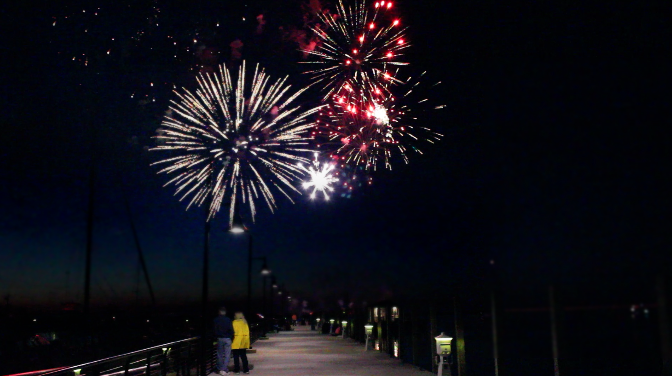
2014 fireworks over Port Austin, Michigan
200 B.C. - A.D. 800: The Birth of Fireworks
Like many inventions, firecrackers and fireworks were created by accident...and by the search for immortality. Around 200 B.C., the Chinese unintentionally invented firecrackers by tossing bamboo into a fire, but it took another thousand years before true fireworks came alive. As the story goes, around A.D. 800, an alchemist mixed sulfur, charcoal and potassium nitrate, hoping to find the secret to eternal life. Instead, the mixture caught on fire, and gunpowder was born. When the powder was packed into bamboo or paper tubes and lit, history had its first fireworks.
If you attended a fireworks show in A.D. 800, it would be unlike anything we see today. Paper fireworks were used to scare evil spirits or celebrate weddings and births and were simply thrown onto a fire, not blasted into the air. There were no added colors, so a fireworks show was just a series of small, noisy explosions. The chemistry was an accidental discovery, and there was still a long way to go.
A.D. 1200 - 1600: War Technology Goes West
Unsurprisingly, it wasn't long before the military adopted gunpowder. By 1200, China had developed rockets and other gunpowder-powered weapons for use against enemies. Off the battlefield, however, this technology led to something beautiful: the first aerial fireworks.
Gunpowder spread westward as European and Arabian diplomats and missionaries began visiting China around this time. Like their Chinese counterparts, Western engineers also developed weapons, this time muskets and cannons, but continued to develop fireworks, and they became larger and more elaborate.
If you attended a fireworks show in 1600, the science would not have been much different from that of ancient China, but it would have been a lot more entertaining. Now used for military victories, religious events or royal celebrations, aerial fireworks, still largely orange-yellow with no vivid colors yet, were run by "firemasters" and their assistants, "green men." Before the show, the green men, named for the leaves they wore to protect themselves from sparks, would tell jokes to the crowd while they prepared the celebration. Being a green man, however, was a highly dangerous position, and many were injured or killed when their fireworks malfunctioned.
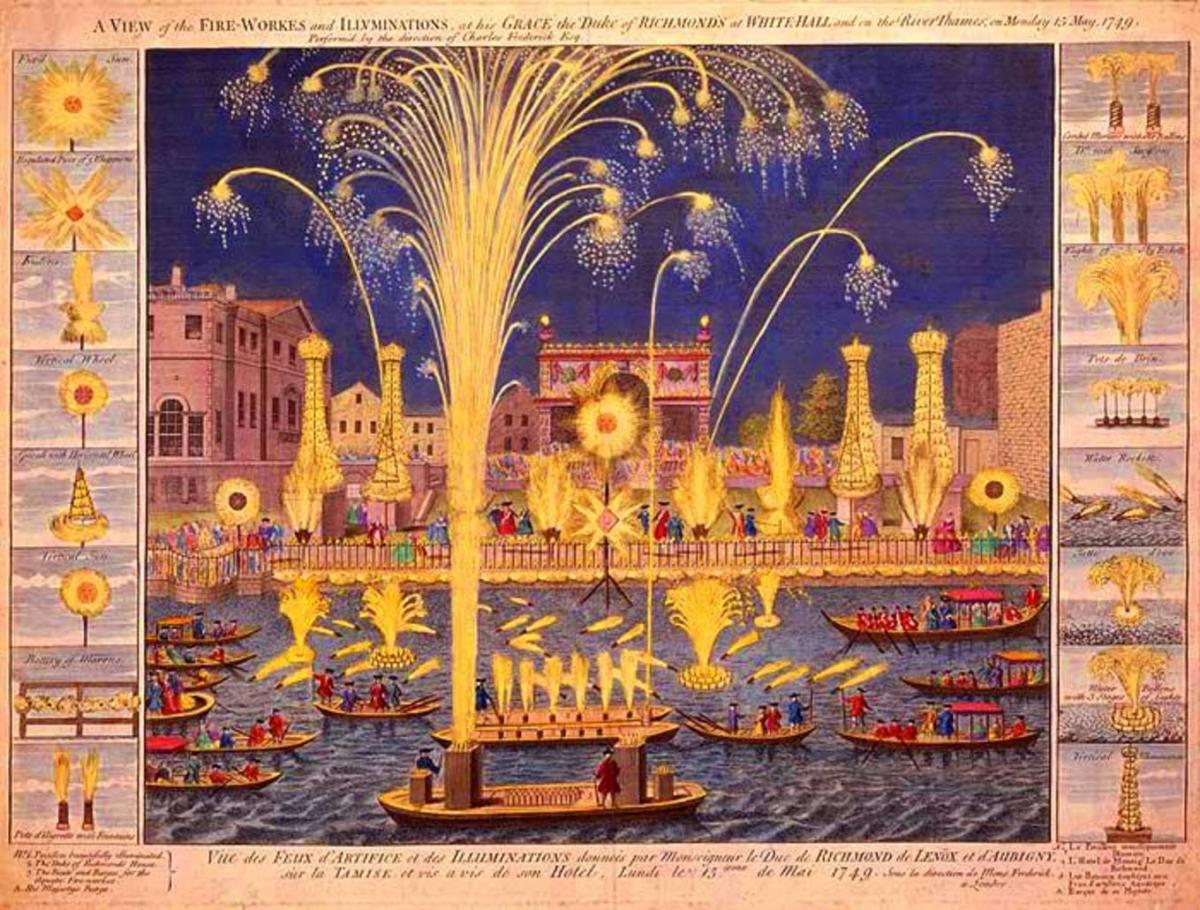 A hand-colored etching of fireworks over the River Thames in 1797, artist unknown
1600 - Present: Enter Color! Modern Fireworks and the Fourth of July
When English royals weren't competing with Europe for the best fireworks display (King James II's firemaster was actually awarded a knighthood for his impressive work), they were introducing fireworks to their 13 colonies across the Atlantic. If you've ever wondered why we celebrate Independence Day with these colorful explosions, you can thank the British and John Adams.
On July 3, 1776, one day before the Declaration of Independence was adopted, Adams wrote this letter to his wife:
"This day will be most memorable in the history of America," he predicted. "I am apt to believe that it will be celebrated by succeeding generations as the great anniversary festival... It ought to be solemnized with pomp and parade... bonfires and illuminations [fireworks]... from one end of this content to the other, from this time forward forevermore."
And so it was. On July 4, 1777, the first anniversary of America's country-hood, there were indeed fireworks, and there would be for more than 200 years to follow.
Of course, if you had been there for America's anniversary, you still would not have seen colored fireworks. The vivid colors we see today would not appear for another 60 years, when Italian pyrotechnicians added metals such as strontium and barium. At long last, in the 1830s, modern colored fireworks were born, and celebrations took on an entirely new light.
If you watch a fireworks show this Fourth of July, you will witness more than 2,000 years of danger, invention and beauty wrapped into a simple package. From exploding bamboo to carefully engineered shells filled with gunpowder and metals, our science, and our world, have come a long way over the past two millennia.
Even the most common science often has a fascinating history. Who knows what the future will bring next?
References
- Cohen, J. (2011, July 1). Fireworks' Vibrant History. Retrieved June 29, 2015, from http://www.history.com/news/fireworks-vibrant-history
- Smith, J. (2014, July 4). The History of Fireworks and the 4th of July. Retrieved June 29, 2015, from http://gearpatrol.com/2014/07/04/quick-flashy-history-fireworks/
- Upton, E. (2013, October 22). The Explosive History of Fireworks. Retrieved June 29, 2015, from http://www.todayifoundout.com/index.php/2013/10/explosive-history-fireworks/